
Healing after incarceration: Why trauma-informed recovery matters
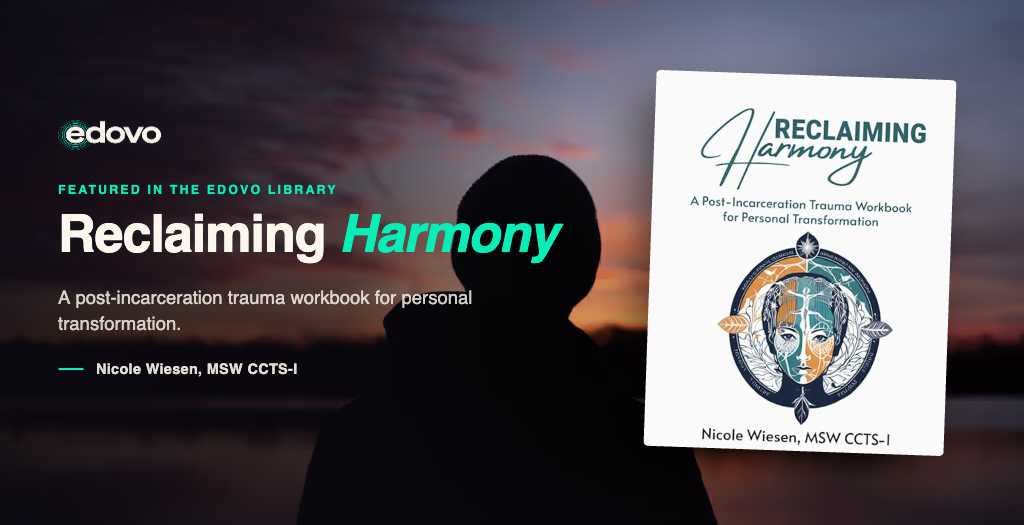
This blog introduces Reclaiming Harmony: A Post-Incarceration Trauma Workbook for Personal Transformation, a new resource on Edovo designed to help learners understand and heal from the lasting effects of trauma and incarceration. The workbook combines reflection, mindfulness, and evidence-based exercises to support emotional healing, self-awareness, and resilience—recognizing that successful reentry requires not only practical skills, but also the opportunity to process past experiences and build a healthier future.
Every day, millions of people across the country are working to rebuild their lives after incarceration.
Much of the public conversation about reentry focuses on the practical challenges people face: finding housing, securing employment, reconnecting with family, and navigating community supervision requirements. These challenges are real and significant. But beneath them often lies another obstacle that receives far less attention: trauma.
That's why we're excited to share that Reclaiming Harmony: A Post-Incarceration Trauma Workbook for Personal Transformation was added to Edovo in May.
This new resource helps learners explore the emotional and psychological impact of incarceration while providing practical tools for healing, self-reflection, and personal growth.
The hidden impact of incarceration
For many people, incarceration is not the beginning of trauma. It is another chapter in a much longer story.
Research consistently shows that incarcerated populations experience significantly higher rates of adverse childhood experiences, exposure to violence, substance use disorders, mental health challenges, and other traumatic life events than the general population. Many people enter correctional facilities already carrying years of unresolved trauma.
Incarceration itself can add another layer.
Separation from family. Loss of autonomy. Constant vigilance. Grief. Uncertainty. These experiences can have lasting effects long after a sentence ends.
At Edovo, we hear learners talk about wanting to change their lives, improve relationships, become better parents, and make different choices moving forward. But meaningful change often requires more than information alone. It requires understanding the experiences that shaped us and developing healthier ways to respond to them.
Why trauma-informed resources matter
Healing from trauma is not simply about moving on from the past. It's about understanding how past experiences continue to influence thoughts, emotions, behaviors, and relationships in the present.
When trauma goes unaddressed, it can show up in ways that make reentry even more difficult:
- Difficulty trusting others
- Emotional dysregulation
- Challenges maintaining healthy relationships
- Increased stress and anxiety
- Feelings of shame or hopelessness
- Difficulty envisioning a positive future
Trauma-informed resources help individuals recognize these patterns while building practical skills to navigate them.
That's where Reclaiming Harmony stands out.
A workbook designed for transformation
Unlike traditional self-help content, Reclaiming Harmony was specifically designed to support individuals navigating life after incarceration.
The workbook combines therapeutic exercises, reflective writing prompts, mindfulness practices, and evidence-based healing strategies into a structured journey of self-discovery and recovery.
Topics include:
- Understanding and processing trauma
- Practicing self-forgiveness
- Rebuilding confidence and self-worth
- Strengthening relationships
- Managing emotional triggers
- Developing resilience
- Building healthy coping mechanisms
- Creating a vision for the future
Throughout the workbook, learners are encouraged to examine their own experiences with compassion rather than judgment. The goal isn't to erase the past. It's to help individuals better understand it so they can move forward with greater clarity and confidence.
Healing is part of reentry
At Edovo, we often talk about education, job readiness, and skill development as critical components of successful reentry. Those areas matter tremendously.
But personal transformation is rarely limited to gaining knowledge or learning new skills.
Many of the people we serve are also doing the difficult work of healing. They're rebuilding relationships with children. Repairing trust with loved ones. Learning how to manage emotions in healthier ways. Creating new identities that aren't defined by their past mistakes.
That work deserves support, too.
Resources like Reclaiming Harmony recognize that rehabilitation is not just about preparing someone for employment. It's about helping people develop the tools, self-awareness, and resilience needed to thrive in every aspect of life.
Creating space for growth
One of the most powerful things we witness through Edovo is people's willingness to invest in themselves.
Every day, learners choose to spend their time developing new skills, exploring difficult topics, and preparing for a better future. That commitment to growth is remarkable.
Healing is rarely linear, and there is no workbook that can solve every challenge. But resources like Reclaiming Harmony can provide a starting point—a structured space for reflection, understanding, and personal transformation.
Because lasting change isn't just about what people learn.
It's also about what they're able to heal.
About the Author of Reclaiming Harmony
Dr. Nicole Wiesen, PhD, LMSW, CCTS-I, is a social worker, researcher, speaker, and founder of NLW Consulting and the Post-Incarceration Syndrome (PICS™) initiative. Drawing from both professional expertise and lived experience, her work focuses on trauma, incarceration, reentry, public health, and social justice. Dr. Wiesen has over 15 years of experience in correctional programming, community-based services, and systems change, and has presented nationally on trauma-informed care, reentry, and the long-term impacts of incarceration. She is currently completing her Master of Public Health (MPH) and is the author of Post-Incarceration Syndrome, advancing research and education on the psychological, social, and public health consequences of incarceration.