
Books that bridge: Connecting incarcerated parents and their kids
Discover how shared stories can bridge the distance between incarcerated parents and their children. This article introduces Books as Bridges for Parenting While Incarcerated, a new Worldreader & Edovo course that uses reading, early childhood science, and simple everyday strategies to help families stay connected and emotionally present, no matter the barriers. Dive in to explore how small moments of storytelling can strengthen bonds, support child development, and bring hope to families on both sides of the wall.
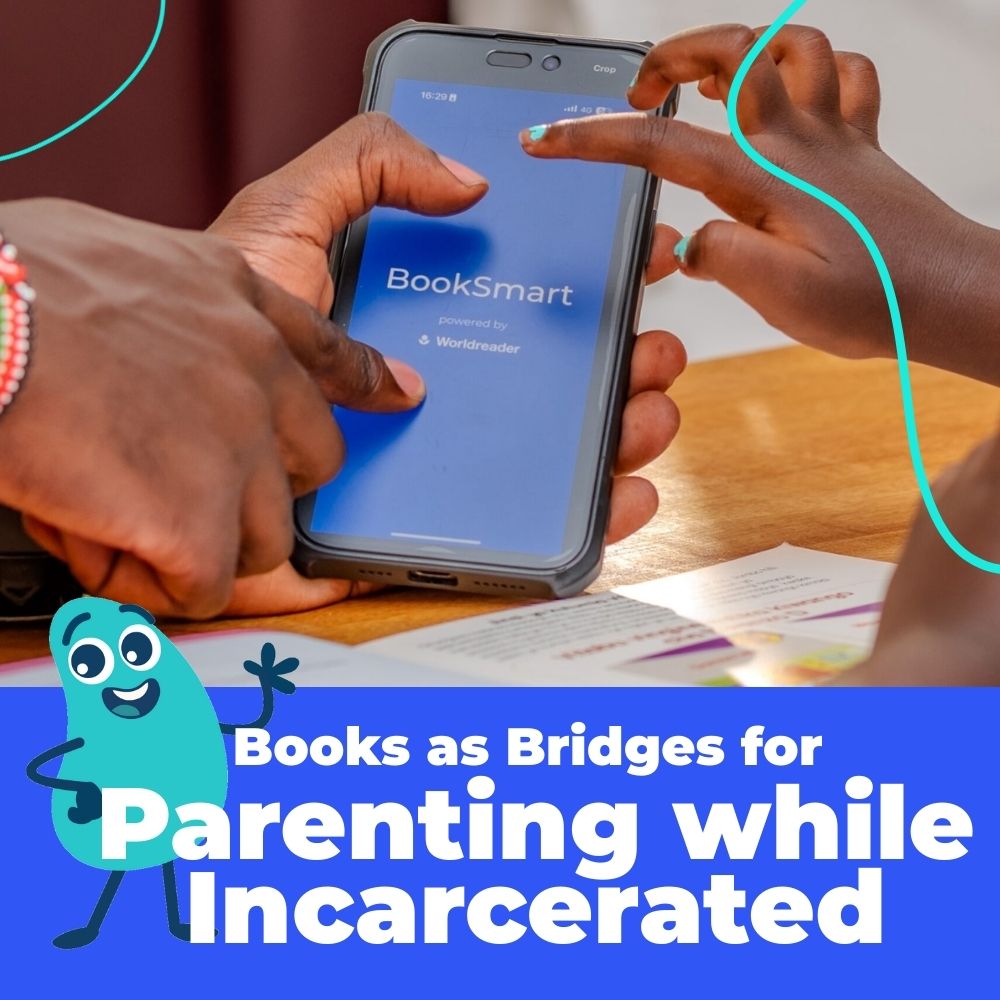
Picture this: An incarcerated parent sits on their bunk, the tablet glowing softly in their hands, reading a story they know their child is also turning the pages of somewhere miles away. On their next call, they get to swap favorite characters, share a laugh, or wonder what might happen next.
It’s more than reading. It’s a ritual of belonging. A bridge across distance. A reminder: I’m still here. I’m still your parent.
Today, that bridge is stronger than ever thanks to the new Books as Bridges for Parenting While Incarcerated course, created by Worldreader and Edovo. Built on both organizations’ shared mission to connect families through reading, this course goes deeper, helping parents understand child development, apply research-backed parenting strategies, and build emotional connection in small, meaningful moments.
A parenting course that meets parents where they are
The course is grounded in a research-based, trauma-informed design. It doesn’t shy away from reality. Instead, it acknowledges the challenges justice-impacted families face and equips parents with practical ways to stay connected across distance and constraints.
To help parents make the most of every interaction, whether during a call, visit, or letter, the course introduces a simple, powerful tool: the PRESENT framework. PRESENT stands for Praise, Routine, Encourage, Specifics, End with Love, Notice, and Tell Stories. Parents practice applying these steps throughout the course, learning to weave them naturally into calls, visits, and letters. It gives parents concrete steps to stay emotionally present even when they can't be physically there.
Throughout the course, parents learn to use books as emotional bridges, understand their child’s developmental needs, stay present despite barriers, and strengthen communication with caregivers. These skills help build a child’s sense of security, confidence, and resilience, no matter the distance.
These moments aren’t small; they’re stabilizing. This isn’t just anecdotal; the science of early childhood development reveals why these connections matter so deeply. Research consistently shows that when children maintain healthy relationships with an incarcerated parent, they experience stronger emotional outcomes, fewer behavior challenges, and healthier long-term development (Kremer et al., 2022; Eddy & Poehlmann-Tynan, 2019).
The science is clear: early childhood is a once-in-a-lifetime window
The first five years of life are extraordinary: a child’s brain forms over one million new neural connections every second. The interactions that fuel this growth, talking, reading, playing, comforting, and wondering aloud, don’t depend on perfect circumstances. They depend on connection.
The course never assumes parents “should just know how” to maintain that connection under difficult conditions. Instead, it teaches concrete, research-backed strategies rooted in early learning science, especially the responsive back-and-forth moments that build language, emotional regulation, and lifelong learning. To make these concepts easy to use in everyday life, the course also includes brain-building tips modeled by characters from Worldreader’s Kooky Kitty series, showing parents simple ways to strengthen connection and support development during calls, letters, and visits. These short, optional videos, also available on Worldreader’s YouTube channel, model playful, accessible activities that boost children’s learning in just a few minutes.
Books naturally rise to the top as one of the most powerful tools. Through Worldreader’s BookSmart app at home and Edovo’s app inside facilities, families can share joyful, developmentally rich stories that give them something meaningful to talk about together, creating fertile ground for these brain-building moments.
The course also recognizes that caregivers, grandparents, aunts, uncles, and foster parents, are often the unsung heroes keeping these connections alive. Their partnership and stability matter deeply for a child’s well-being, and the brain-building tips and activities are designed to support and celebrate their essential role.
Turning books into bonding
One of the course’s most engaging features is a set of ten children’s stories, each paired with three original Play–Read–Grow activities that turn reading into relationship-building. These activities are simple, joyful, and designed to work during visits, calls, letters, or at home with a caregiver. Supported by the PRESENT framework, parents have practical ways to Praise, Notice, Encourage, and End with Love as they guide their child through the story.
- Play activities turn stories into hands-on, imaginative experiences that help children explore themes through movement, creativity, and pretend play.
- Read activities guide children to think like active readers by making predictions, noticing details, asking questions, and exploring key ideas in the text.
- Grow activities help children connect story themes to their own lives, nurturing emotional awareness, reflection, and values like courage, gratitude, and community.
Together, these tools make reading a shared experience that builds confidence, curiosity, and emotional connection, no matter where each family member is.
A new chapter for families
At its heart, the Books as Bridges for Parenting While Incarcerated course is about one thing:
Every child deserves connection. Every parent deserves a way to show up.
A story shared between bursts of phone static.
A silly question that sparks laughter on both ends of the line.
A loving sentence repeated at the end of every call.
These moments build resilience. They help children feel seen and supported, even in complicated circumstances. And they help parents rediscover their voice, their role, and their hope.
This course works best when everyone plays a part. Here's how you can support family connection, whether you're caring for a child at home or creating space for families to read together.
For Caregivers: You're the Connection Keeper
If you're caring for a child with an incarcerated parent, you make the connection possible. Here's how it works:
- The incarcerated parent chooses a story and Play–Read–Grow activity from the course on Edovo.
- You bring that activity to life at home, reading together, acting out scenes, drawing, or talking about meaningful moments from the story.
- Then you help the child share what they created during the next phone call, letter, or visit.
Tip: Find the same books on Worldreader's BookSmart app for free so you and the child can read along at home. When parent and child experience the same story, distance transforms into connection.
For Correctional Staff: Small Spaces, Big Impact
Correctional staff can support family bonding by creating simple reading nooks in visitation areas, calm corners with children’s books, comfortable seating, and small moments of privacy where families can read, talk, and connect.
Reading nooks don’t require much: a rotating selection of children’s books, a quiet space, and gentle encouragement for families to use it. These spaces help parents practice PRESENT strategies, share stories with their children, and build connection through uninterrupted time together.
Parents who may feel uncertain about reading aloud have access to animated videos that model how to try out brain-building activities with young children, which are available directly within the course, and offer another powerful pathway into engagement. These short videos model simple, play-based interactions that parents and children can watch together and then emulate, building confidence, supporting early childhood development, and strengthening the bond even when words don’t come easily.
Staff can enhance visits by pointing out the reading nook, keeping age-appropriate books available, and letting parents know they can choose activities or videos from the Books as Bridges course to share during their time together.
Because even when walls divide families, shared stories and simple moments can bridge the space between them.
References
Kremer, K. P., Christensen, K. M., Stump, K. N., Stelter, R. L., Kupersmidt, J. B., & Rhodes, J. E. (2022). The role of visits and parent–child relationship quality in promoting positive outcomes for children of incarcerated parents. Child & Family Social Work, 27(2), 206–216. https://doi.org/10.1111/cfs.12872
Eddy, J. M., & Poehlmann-Tynan, J. (Eds.). (2019). Handbook on children with incarcerated parents: Research, policy, and practice (2nd ed.). Springer.